 Historic Nafplio 3D
Museum · Nafplio
Archaeological Museum
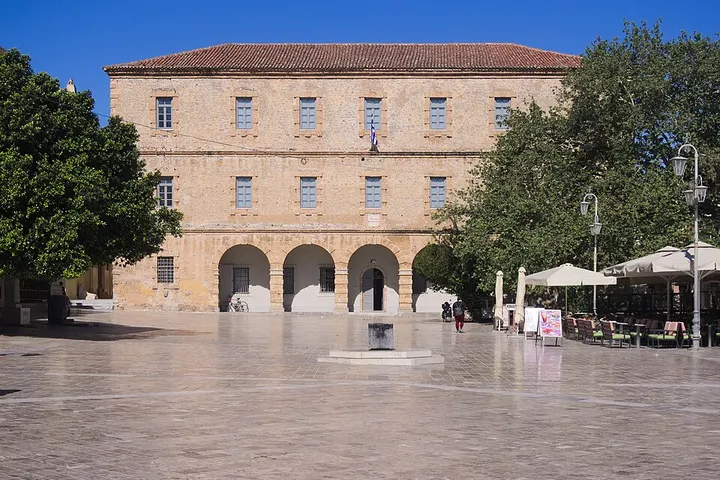
A Venetian naval storehouse of 1713 closing the west side of Syntagma Square. It now holds finds from across the Argolid, from the Palaeolithic to Roman times.
History
The three-storey stone building was put up in 1713, during the second Venetian period, by the fleet commander Agostino Sagredo, as the Latin inscription on its front records. It probably served as a naval storehouse. After liberation it stayed in military hands as a barracks, a regimental headquarters and an officers' club. Since the early 1930s it has housed the Archaeological Museum, which was fully renovated in 2003–2008. Its two halls show finds from Tiryns, Midea, Dendra, Asine and the Franchthi Cave. The best-known exhibit is the Mycenaean armour from Dendra (late 15th century BC). The winged lion of St Mark still sits above the entrance.
Periods of history
- Second Venetian (1686–1715)
- Second Ottoman (1715–1822)
- Revolution · first capital (1822–1833)
- King Otto (1833–1862)
- 1862–1940
- Since 1940