 Historic Nafplio 3D
Church · Nafplio
Agia Moni (Areia)
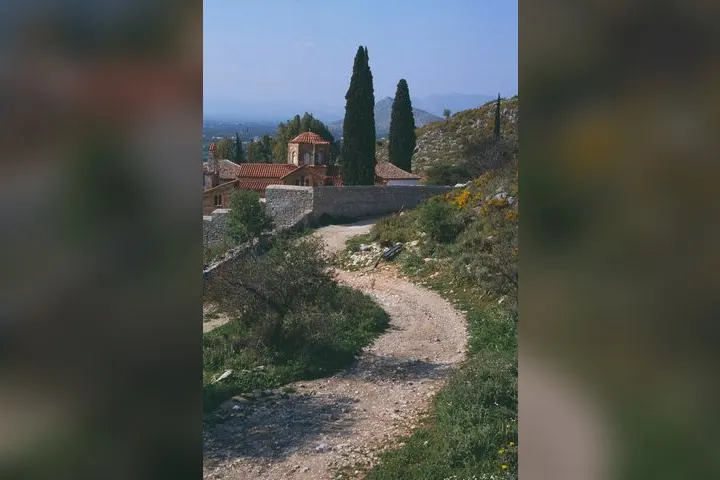
Byzantine monastery of 1149 at Areia, east of Nafplio, founded by Leo, bishop of Argos and Nauplia; today a convent of the Life-giving Spring.
History
A founder's inscription built into the narthex dates the church to 1149 and names its donor, Leo, bishop of Argos and Nauplia. The katholikon is a fine example of 12th-century architecture: a four-column cross-in-square church with an octagonal dome, cloisonné masonry and rich ceramic decoration; the bell tower is later and the original wall paintings are lost. The monastery kept its Orthodox worship under the Franks, became a dependency of the Holy Sepulchre of Jerusalem in 1679 and was a centre where manuscripts were copied. It was dissolved in 1833 by Otto's Regency and reopened in 1875, dedicated to the Life-giving Spring. Today it is a convent and celebrates on Bright Friday, the Friday after Easter. Since the 19th century the spring in the monastery garden has been identified with ancient Kanathos, where, Pausanias was told, Hera bathed every year to renew her maidenhood; its water comes from an ancient shaft.
Periods of history
- Antiquity
- Byzantine
- Frankish (1212–1389)
- First Venetian (1389–1540)
- First Ottoman (1540–1686)
- Second Venetian (1686–1715)
- Second Ottoman (1715–1822)
- Revolution · first capital (1822–1833)
- King Otto (1833–1862)
- 1862–1940
- Since 1940